

The Impact of Artificial Intelligence on Work
The Impact of Artificial Intelligence on Work: Why AI Is Exhausting Us Instead of Setting Us Free
THOUGHTS
Frederic Sitruk
3/20/20263 min read
Introduction
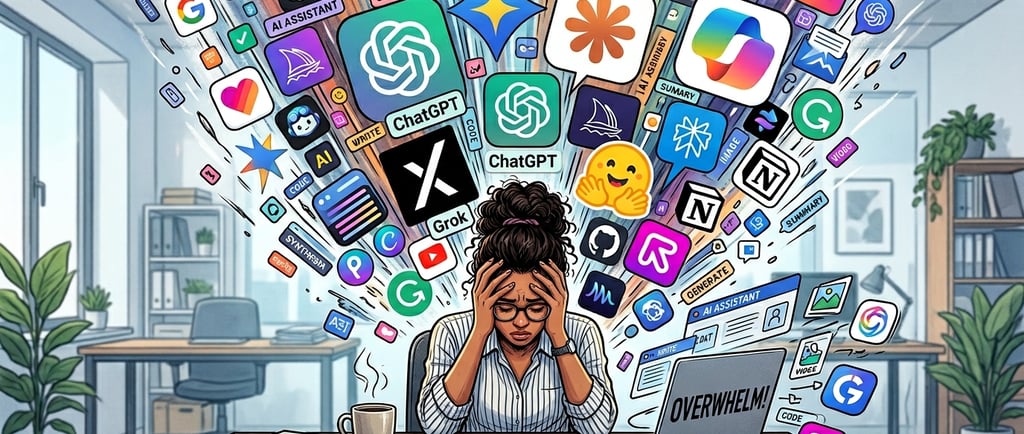
Artificial intelligence promises time savings, increased productivity, and the automation of low-value tasks. Yet more and more professionals are experiencing the opposite: mental overload, cognitive fatigue, and a growing difficulty to slow down.
Why does AI—supposed to simplify work—sometimes feel like it’s accelerating the pace and increasing pressure?
This article explores the real impact of artificial intelligence on our relationship with time, productivity, and performance.
We thought the problem was a lack of time.
We were wrong.
Today, time is here.
Accessible. Compressed. Optimized.
And yet…
Something feels off.
We do more.
We move faster.
We produce better.
But we don’t feel more free.
As if every minute gained creates a new obligation.
Not a liberation.
An acceleration.
An acceleration that never really stops.
We Were Promised Time
Time saved.
Time freed.
Time to finally breathe.
But this time never stays empty.
It is immediately captured by:
new ideas
new optimizations
new possibilities
What used to take a full day now takes an hour.
So we don’t stop. We add.
One more project
One more improvement
One more ambition
And very quickly, without realizing it:
I could do more
I should do more
The shift is subtle, but it is decisive.
The Impact of Artificial Intelligence on Productivity: An Invisible Trap
No one is putting pressure on you.
There is no explicit demand.
No visible constraint.
But something else is at play:
Awareness of potential
Immediate access to tools
Ease of execution
Everything becomes achievable.
And when everything becomes achievable… letting go becomes difficult.
So you move forward.
Again.
Not because you have to, but because you can.
And that is exactly where the trap closes.
Does AI Really Save Us Time?
In theory, yes.
Artificial intelligence automates many tasks and increases productivity.
In practice, this saved time is often reinvested into new tasks, leading to cognitive overload, mental fatigue, and difficulty slowing down.
Freed Time Becomes an Expectation
Time gained does not become rest.
It becomes an opportunity.
And every opportunity carries an implicit question:
What are you going to do with it?
So you fill it.
Even when it’s not necessary.
Even when you could stop.
Emptiness becomes uncomfortable.
The Silent Guilt
This is not a brutal pressure.
It’s more subtle. A diffuse tension.
Doing nothing becomes uncomfortable
Slowing down feels like losing an advantage
Stopping feels like a lack of ambition
As if every empty space had to be justified.
Before:
I don’t have time
Today:
I need to deserve this time
And this shift is profound.
Because it doesn’t come from outside.
It comes from within.
An Invisible Debt
Freed time creates a form of mental debt.
Since you can do more:
why aren’t you doing it?
Since it’s fast:
why wait?
Since it’s easy:
why stop?
These questions are never asked out loud.
But they are there. Constantly. And they exhaust you.
Cognitive Fatigue and Artificial Intelligence: Why Our Brain Saturates
This is not a traditional overload.
It’s not:
too much work
It’s:
too many possibilities
Too many options
Too much stimulation
Too many micro-decisions
The brain no longer rests. It constantly arbitrates.
What to do. What to improve. What to start next.
Even in stillness… the activity continues.
Why Artificial Intelligence Is Not the Problem (But Our Use of It Is)
AI works. Perfectly.
It amplifies. It accelerates. It simplifies. It does exactly what we expect it to do.
The problem is not technological.
It’s Our Relationship with “More”
We have not learned to limit ourselves. Only to:
exploit
optimize
expand
So when limits disappear… we don’t balance. We intensify.
Until saturation.An Uncomfortable Question
What if the real issue is not:
what AI allows us to do
But:
what we are capable of not doing
What we choose to leave aside.
What we accept not to optimize.
Beyond Work: A Question of Our Relationship with Time
This goes beyond work. It touches:
our relationship with time
our relationship with value
our relationship with enough
At what point is it enough?
A question that has become rare.
A New Form of Mastery
In a world of abundant resources… scarcity shifts.
Into attention
Into energy
Into the ability to say no
Refusing an optimization.
Letting an idea exist without executing it.
Not filling every empty space.
This is not giving up.
It is choosing.
It is taking back control.
Conclusion: Is AI a Solution or an Accelerator?
Artificial intelligence is deeply transforming the way we work. While it enables time savings, it also reshapes our relationship with productivity and can intensify internal pressure.
Understanding these dynamics is essential to use AI consciously and avoid mental overload or gradual burnout.
Contact
Follow us:
Let's talk about your challenges and accelerate your impact
© 2025. All rights reserved.