


Quiet Cracking
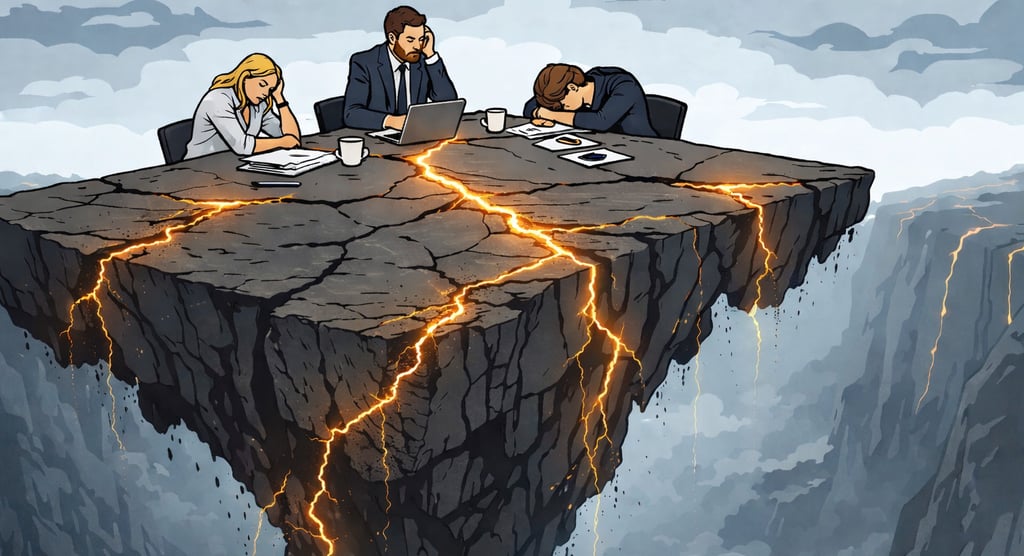
*Quiet cracking* is when a team still appears to function, but is quietly weakening from within because there’s no space to name, regulate, and adjust what’s wearing it down.
Frederic Sitruk
2/23/20263 min read
Quiet Cracking
When Teams Don’t Burn Out. They Fracture.
They’re here.
Competent. Committed. Responsible.
Meetings happen.
Decisions get made.
Results—so far—still hold.
Nothing explodes.
Nothing collapses.
And yet something is deteriorating.
It’s not an open crisis.
It’s not a visible burnout.
It’s not a resignation announcement.
It’s quieter.
Slower.
Deeper.
It’s what more and more organizations are now experiencing:
quiet cracking.
Fatigue Without a Name
For a long time, professional exhaustion was loud.
It showed up as sick leave, alarms, and clean breaks.
Today, it has changed shape.
Fatigue doesn’t shout anymore.
It seeps in.
It settles into:
the loss of drive
the decline in initiative
emotional disengagement
People keep doing the work.
They meet their commitments.
But they are no longer fully there.
They hold.
They absorb.
They adapt.
Until one day, something gives.
Quiet Cracking: A Collective Wear
Quiet cracking isn’t an individual problem in disguise.
It’s not about personal fragility or a lack of resilience.
It’s a collective phenomenon.
It emerges when:
pressure becomes chronic
adjustments are made alone
tensions no longer have a place to be expressed
Each person adapts on their own.
And that solitary adaptation weakens the whole.
It’s not workload that breaks teams.
It’s the absence of collective regulation.
What Cracks First: The Bond
In teams experiencing quiet cracking, what deteriorates first isn’t competence.
It’s the living bond between people.
The bond that makes it possible to say:
“I can’t do it the way I used to.”
“This pace isn’t sustainable.”
“We’re avoiding the real issue.”
When that bond tightens, speech contracts.
You choose your words.
You avoid certain topics.
You postpone.
Gradually, a gap forms between:
what is lived
and what can be said
That gap is where wear begins.
The Professionalism Trap
Quiet cracking is even more dangerous because it is socially rewarded.
It’s often mistaken for:
professionalism
responsibility
emotional maturity
“It’ll be fine.”
“We’ll adapt.”
“Not the right time.”
These sentences are rarely lies.
They’re temporary renunciations… that become permanent.
Over time, not saying things can even blur feeling itself.
Wear becomes vague.
Hard to name.
So hard to address.
When Performance Masks Fragility
Paradoxically, quiet cracking often develops in high-performing teams.
Teams that:
deliver under pressure
absorb constant change
“push through”
Performance becomes a screen.
It hides the fragility of the system.
Everything seems fine
because it still works.
But that “working” is often achieved:
at the cost of individual energy
at the expense of meaning
with no margin left
These are teams that hold…
but can no longer absorb an additional shock.
The Invisible Cost of Silence
What isn’t said doesn’t disappear.
It moves.
Accumulated silence becomes:
cynicism
irritability
emotional distance
Conversations become more technical.
Less human.
Less true.
Tensions aren’t resolved.
They’re bypassed.
And bypassing comes at a massive cost:
to decision quality
to trust
to real commitment
Why Classic Responses No Longer Work
Faced with this diffuse fatigue, organizations often offer:
well-being initiatives
individual support
resilience training
These can help.
But they remain insufficient.
Why?
Because they treat symptoms, not the system.
Quiet cracking doesn’t come from a lack of individual resources.
It comes from a failure of collective regulation.
Reintroducing Spaces for Regulation
A healthy team isn’t a team without tension.
It’s a team that can turn tension into information.
That requires:
spaces where speaking isn’t immediately judged
time to slow down before things break
shared responsibility for the relational climate
Regulation isn’t a luxury.
It’s a vital function.
Without it, teams wear out in silence.
The Role of Team Coaching
Team coaching isn’t here to “motivate” or “fix” people.
It works at a different level.
Its aim is to:
reopen psychologically safe spaces for speech
make latent tensions visible
help the team self-regulate
It’s not about saying everything.
It’s about being able to say what matters.
When a team regains that capacity, something shifts profoundly.
What Changes When Speech Returns
When a team can name:
what is exhausting
what is irritating
what is blocking
Then:
workload becomes adjustable
decisions gain clarity
trust rebuilds
Performance doesn’t disappear.
It re-anchors in reality.
The team stops forcing.
It realigns.
The Real Stake of Quiet Cracking
Quiet cracking isn’t an organizational failure.
It’s an early warning signal.
A signal that says:
“We need to pause for a moment
so we can continue differently.”
Teams aren’t asking for less rigor.
They’re asking for more rightness.
What wears teams down isn’t intensity.
It’s the inability to work with it together.
Contact
Follow us:
Let's talk about your challenges and accelerate your impact
© 2025. All rights reserved.